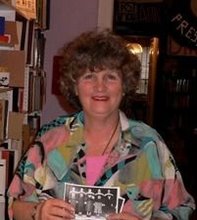
After a day of wind and rain squalls, La Professora and I made our way to Dante's pub-cafe, a gathering place for an eccentric mix of devotees. On this night I was to be part of the Melbourne book launch for a collection of photographs--by Del LaGrace Volcano-- and text--by Ulrika Dahl-- about an international community of women who define as femme. I want to share with you my contribution to this moving and at times powerful event.
March 14, 2009
Thank you Liz and Ulrika for inviting me to be part of this evening.
My words tonight, this expression of my fem power, grew out of the courage of the young fem-butch, trans people, lesbian-feminist people, peace and gender queer activists, Palestinian and Israeli, with whom I spoke in Haifa, Tel Aviv and Jerusalem two years ago. Out of the courage of Rauda Marcos, one of the founders of ASWAT, the Palestinian Lesbian Organization, who fights for the lives of all her peoples on so many fronts. Out of the words of Sonya of Australian Women for Palestine who lead me to the poetry and life of Mahmoud Darwish, the revered Palestinian poet who died at age 67 on August 11, 2008 in exile and who lived his life labeled "a present-absent alien" by the Israeli government. I will carry his words on this femme body for the rest of my life.
From my journal, June 22, 2007
Our friends in Haifa made us see with their eyes and so we saw through landscapes to deeper histories. When we first travelled the roads between Tel Aviv and Haifa, our eyes fell off the scrub hills, but Hannah asked us to look again. "See those prickly pear cactuses"--and she slowed the car down so we could focus our gaze--"Every time you see a cluster of them, you are looking at the ruins of a Palestinian home. The farmers used the plant to form natural corrals for their grazing animals and also ate the fruit born at the tip of the rounded leaf." We started to look deeper, longer, and soon we could see the tracings of another people, not a long gone people,but a recently displaced people. Stone foundations started to appear, buried in the surviving scrub. May you all have friends who make you look again. But when you see, there is no return to blankness, to cruel triumphalism.
The Poet: "Ah, the country where we see only what is not seen; our secret/We travel like other people but we return to nowhere...We have a country of words. Speak speak so I can put my road on the stone of a stone. We have a country of words. Speak speak so we may know the end of this travel.
Dear Poet, how did I find you, through dusty roads of unknown histories, you whose words live on so many tongues and yet I was so ignorant of the love you poured into your differently metered lines, of your swirling solid notes of exile, of the white mare that runs down into the valleys no longer safe, that drinks from your fathers' wells, now empty of their sense of self. I came as a stranger, a Jewish femme stranger into your cadences of loss and exultation, into your Andalusian sunsets and endless stony roads that lead to children carrying fathers on their backs, to endless journeys past familiar olive trees but with no rest allowed, no fruit given.
The Poet: " (to the killers) If you'd contemplate the victim's face/and thought, you would have remembered your mother in the gas chamber/ you would have liberated yourself from the rifle's wisdom/and changed your mind; this isn't how identity is reclaimed."
I stood in front of the gray looming wall that divided life from life, that marked the loss of history for one people and the loss of a soul for another. That impenetrable wall, with its razor wire far above us, froze my queer fem body. And that is why I am here tonight. For many years, I have written, mapped, tracked the power of my fem desire, the strength of my thighs to grip the wanted body and shake it loose of its hard places, to offer my fullness of desire and flesh as a way through, as a break in the wall, as a yearning that refuses solid borders and policed boundaries. I have reveled in the thrust of penetration, the opening in the wall; I have been a port of entry, a simple thing, a taking in, an offered warmth, a way in, a break in the wall. In other writings I have charted how desire for a certain kind of touch can push a woman off the map. And on that bare sandy road in East Jerusalem facing the wall's brutal solidity, I had the inkling of a fem politic, something beyond my earlier years' celebration of the fem-butch courage that walked the hate-filled streets of Joseph McCarthy's America. How does a fem face history, how does my body, always the speaker of my desires, confront the atrophies of national compassion that so mark our world. A port of entry, a simple thing, a taking in, an opening in the wall. Over ruins so huge they threaten to block out all hope, your words find me. I have tasted your heat, seen the olive trees in exile, decorative in the gardens of the usurpers. What a strange two the world would think us, a 50s fem from the Bronx, the dying poet who lives in every Palestinian heart--but the only way I can live in a world now where such a wall exists is to take your words into my mouth.
The Poet: "I am my language. I am what the words said: Be my body. Be the crossroads between my body and the eternal desert...there is no land to carry me above the earth so my speech carries me.
This is my language, collars of stars around the necks of lovers, my steps are of wind and sand/ my world is my body and what my hands possess/I am the traveller and the path.
The poem is what lies between a between. It is able to illuminate the night with the breasts of a young woman/it is able to illuminate, with an apple, two bodies/it is able to restore/ with the cry of a gardenia, A Homeland.
In Jerusalem and I mean within the ancient walls, I walk from one epoch to another without a memory to guide me...I was walking down a slope and thinking to myself: how do the narrators disagree over what light said about a stone? Is it from a dimly lit stone that wars flare up?... I think to myself, alone the prophet Mohamed spoke classical Arabic--'And then what? Then what?' a woman soldier shouted: Is that you again? Didn't I kill you?' I said: you killed me...and I forgot, like you, to die."
At the end of the two hour talk at the University of Tel Aviv, a group of fem women came up to talk with me about the difficulties they faced, the judgements from all sides that accompanied their lives. As they spoke and I comforted I saw their beauty. That night we spent in the Jerusalem home of one of the founders of Women in Black in Israel, the following day we stood vigil in the heart of the city--Gila took us through the streets, crossing over into East Jerusalem, traveling along the wall surrounding Bethlehem, stopping at the checkpoint controlling Palestinian entry and departures from their own land, and finally into the hectic histories of the old city. A long hard day. In the evening another communal sharing of food. Many of the young people who had been present at the Queer sexuality talk had made their way to Gila's house. Feeling a little tired, I sat in a chair in the backyard, taking in the scents of the warm night air, the sounds of Jerusalem, and one by one the students and their friends came to sit around me. They wanted stories of the body, these young queer peace makers, wanted tales of how we survived the bigotries of another time, how we found each other and tried to imagine another world. We leaned into each other and again I saw the beauty of the unarmed human body, their hopes for another kind of future held in their bare arms. "Come back to us," one of the young femme women said, "when the occupation is over."
Selected Books by Mahmoud Darwish
Why Did You Leave the Horses Alone? Trans. by Jeffrey Sacks, 2006.
Unfortunately, It Was Paradise. Trans. by Munir Akash and Carolyn Forche, 2003.
Memory for Forgetfulness. August, Beirut, 1982. Trans. Ibrahim Muhawi, 1995.
The Butterfly's Burden. Trans. by Fady Joudah, 2007.
March 14, 2009
Thank you Liz and Ulrika for inviting me to be part of this evening.
My words tonight, this expression of my fem power, grew out of the courage of the young fem-butch, trans people, lesbian-feminist people, peace and gender queer activists, Palestinian and Israeli, with whom I spoke in Haifa, Tel Aviv and Jerusalem two years ago. Out of the courage of Rauda Marcos, one of the founders of ASWAT, the Palestinian Lesbian Organization, who fights for the lives of all her peoples on so many fronts. Out of the words of Sonya of Australian Women for Palestine who lead me to the poetry and life of Mahmoud Darwish, the revered Palestinian poet who died at age 67 on August 11, 2008 in exile and who lived his life labeled "a present-absent alien" by the Israeli government. I will carry his words on this femme body for the rest of my life.
From my journal, June 22, 2007
Our friends in Haifa made us see with their eyes and so we saw through landscapes to deeper histories. When we first travelled the roads between Tel Aviv and Haifa, our eyes fell off the scrub hills, but Hannah asked us to look again. "See those prickly pear cactuses"--and she slowed the car down so we could focus our gaze--"Every time you see a cluster of them, you are looking at the ruins of a Palestinian home. The farmers used the plant to form natural corrals for their grazing animals and also ate the fruit born at the tip of the rounded leaf." We started to look deeper, longer, and soon we could see the tracings of another people, not a long gone people,but a recently displaced people. Stone foundations started to appear, buried in the surviving scrub. May you all have friends who make you look again. But when you see, there is no return to blankness, to cruel triumphalism.
The Poet: "Ah, the country where we see only what is not seen; our secret/We travel like other people but we return to nowhere...We have a country of words. Speak speak so I can put my road on the stone of a stone. We have a country of words. Speak speak so we may know the end of this travel.
Dear Poet, how did I find you, through dusty roads of unknown histories, you whose words live on so many tongues and yet I was so ignorant of the love you poured into your differently metered lines, of your swirling solid notes of exile, of the white mare that runs down into the valleys no longer safe, that drinks from your fathers' wells, now empty of their sense of self. I came as a stranger, a Jewish femme stranger into your cadences of loss and exultation, into your Andalusian sunsets and endless stony roads that lead to children carrying fathers on their backs, to endless journeys past familiar olive trees but with no rest allowed, no fruit given.
The Poet: " (to the killers) If you'd contemplate the victim's face/and thought, you would have remembered your mother in the gas chamber/ you would have liberated yourself from the rifle's wisdom/and changed your mind; this isn't how identity is reclaimed."
I stood in front of the gray looming wall that divided life from life, that marked the loss of history for one people and the loss of a soul for another. That impenetrable wall, with its razor wire far above us, froze my queer fem body. And that is why I am here tonight. For many years, I have written, mapped, tracked the power of my fem desire, the strength of my thighs to grip the wanted body and shake it loose of its hard places, to offer my fullness of desire and flesh as a way through, as a break in the wall, as a yearning that refuses solid borders and policed boundaries. I have reveled in the thrust of penetration, the opening in the wall; I have been a port of entry, a simple thing, a taking in, an offered warmth, a way in, a break in the wall. In other writings I have charted how desire for a certain kind of touch can push a woman off the map. And on that bare sandy road in East Jerusalem facing the wall's brutal solidity, I had the inkling of a fem politic, something beyond my earlier years' celebration of the fem-butch courage that walked the hate-filled streets of Joseph McCarthy's America. How does a fem face history, how does my body, always the speaker of my desires, confront the atrophies of national compassion that so mark our world. A port of entry, a simple thing, a taking in, an opening in the wall. Over ruins so huge they threaten to block out all hope, your words find me. I have tasted your heat, seen the olive trees in exile, decorative in the gardens of the usurpers. What a strange two the world would think us, a 50s fem from the Bronx, the dying poet who lives in every Palestinian heart--but the only way I can live in a world now where such a wall exists is to take your words into my mouth.
The Poet: "I am my language. I am what the words said: Be my body. Be the crossroads between my body and the eternal desert...there is no land to carry me above the earth so my speech carries me.
This is my language, collars of stars around the necks of lovers, my steps are of wind and sand/ my world is my body and what my hands possess/I am the traveller and the path.
The poem is what lies between a between. It is able to illuminate the night with the breasts of a young woman/it is able to illuminate, with an apple, two bodies/it is able to restore/ with the cry of a gardenia, A Homeland.
In Jerusalem and I mean within the ancient walls, I walk from one epoch to another without a memory to guide me...I was walking down a slope and thinking to myself: how do the narrators disagree over what light said about a stone? Is it from a dimly lit stone that wars flare up?... I think to myself, alone the prophet Mohamed spoke classical Arabic--'And then what? Then what?' a woman soldier shouted: Is that you again? Didn't I kill you?' I said: you killed me...and I forgot, like you, to die."
At the end of the two hour talk at the University of Tel Aviv, a group of fem women came up to talk with me about the difficulties they faced, the judgements from all sides that accompanied their lives. As they spoke and I comforted I saw their beauty. That night we spent in the Jerusalem home of one of the founders of Women in Black in Israel, the following day we stood vigil in the heart of the city--Gila took us through the streets, crossing over into East Jerusalem, traveling along the wall surrounding Bethlehem, stopping at the checkpoint controlling Palestinian entry and departures from their own land, and finally into the hectic histories of the old city. A long hard day. In the evening another communal sharing of food. Many of the young people who had been present at the Queer sexuality talk had made their way to Gila's house. Feeling a little tired, I sat in a chair in the backyard, taking in the scents of the warm night air, the sounds of Jerusalem, and one by one the students and their friends came to sit around me. They wanted stories of the body, these young queer peace makers, wanted tales of how we survived the bigotries of another time, how we found each other and tried to imagine another world. We leaned into each other and again I saw the beauty of the unarmed human body, their hopes for another kind of future held in their bare arms. "Come back to us," one of the young femme women said, "when the occupation is over."
Selected Books by Mahmoud Darwish
Why Did You Leave the Horses Alone? Trans. by Jeffrey Sacks, 2006.
Unfortunately, It Was Paradise. Trans. by Munir Akash and Carolyn Forche, 2003.
Memory for Forgetfulness. August, Beirut, 1982. Trans. Ibrahim Muhawi, 1995.
The Butterfly's Burden. Trans. by Fady Joudah, 2007.