Photograph by Tamir Lederberg
Tuesday, July 1, 2008
A Night in Jerusalem
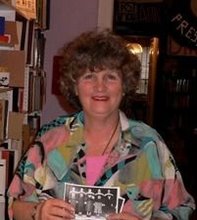
The wonderful women who translated my stories for the Hebrew edition, "Passion, Body and Resistance Stories" : Il-Il Kofler, Shirly Tal, Mariana Bar, Yasmin Piamenta, Haya Shalom in the center with the flowers, Nuphar Lipkin, Efrat Rotem, Talma Bar-Din and Hannah Safren, June 3, 2008, Jerusalem
I have not been feeling well and so the words, while in my head and in my heart--those most real and mythical of places--have stopped at the gate. When I can, I read Amos Oz's memoir, A Tale of Love and Darkness, and feel as if I am with a Jewish Dickens, only the characters who live on his childhood street in Jerusalem are real people, the men and women with Russian names, Polish names, Latvian names who fled the forests and cities of a Eastern Europe that was already turning on their Jewish citizens, before Hitler, the ground was richly prepared. "It may be a little hard for you to understand," says the young boy's aunt, "but in those days [the 1930s] all the Poles were drunk on Polishness, the Ukranians were drunk on Ukrainianness, not to mention the Germans, the Czechs, all of them, even the Slovaks, the Lithuanians, and Latvians, and there was no place for us in that carnival, we didn't belong and we weren't wanted. Small wonder that we too wanted a nation, like the rest of them. What alternative had they left us?" (p 186) I fall into his voices, I taste the brown bread, those thick squares of rich dense bread, sweet and nutty that I would pick off the counter top of Murray's, the surviving deli near my West 92nd home in Manhattan. Before my eyes, Oz recreates the torments and exiles, the creations and tastes, the madnesses and romances of the Jewish intelligensia who found themselves in the dusty streets of pre Israel Palestine. I have so much to learn and my time is short but as I read Oz, I want to cry out, to my Jewish friends who think I have deserted my Jewishness, I have carried within me the Yiddish words of every day life--the head, the pain, the laughing despair, the loved fool, the sheina madel, my mother's hand, so stained by daily work, on my forhead, soothing the fever that was to never leave-- all the days of my life, the seasonal rhythms of the garment trade, the need for books and more books, for ideas about the world and the self and the need for justice in the face of power. Displacement after displacement, recreation of selves--and the dust swirls around their toes and the talk never stops and it must never stop until this tortured place gives home to all its histories. Salaam, Shalom, Shalom, Salaam.
On Thursday, the 23rd of June in the Cinematique Theater in Jerusalem a group of women launched their Hebrew translation of my work and told their own stories of desire and resistance. How can a writer thank enough all those who labor over her words to bring them to life in another tongue.
Saturday, June 21, 2008
Sweetness, sweetness...
I was standing lopsidedly to give my bad leg a rest, putting the finishing touches to an apple pie I was baking for our dinner with Joel and Daniel tonight, when on the ABC radio came a distinctly American voice--how the perpetually youthful sounding vowels jump out at me now--talking about the My Lai massacre of March 16, 1968. Every brown-sugared curve of apple that I set in place was accompanied by another voice, testimony from the past, detailing the revenge killings by Charlie Company and others it is now known of over 300 "unarmed combatants" as the soldiers were carefully trained to say--children gunned down as they fled, as they stumbled across American soldiers, who had orders to wipe out the village. "We had to destroy the village to save it." The program was a radio documentary following the investigative trials, the words of survivors on both sides, the unlivable lives of some of the soldiers haunted years afterwards by their actions, the courage of the American war photographer who made his photos of the event part of the public record, the journalist Seymour Hersh who would not let go of the story, the judges who pushed for the "truth" and those who did not. Apple slice after apple slice slipped so comfortingly into its pastry home; how American was I at this moment, I thought. Baking the good old American standby, as American as apple pie, while listening to the archived horrors of the madness of an American war, how domestic a woman I was, even if I was living with a woman and planning a dinner for other queer loved ones. How old I was, thinking of the wars that have held me in their grip--of the notion that "revenge" for the losses of friends in battle is piled on top of the required aggression to fight any war, that "revenge," that almost most domestic of human failures, so often coupled with jealousy, becomes a "new" emotion over and over again, so the regular killing continues but massacres are a special moment in war, that last death was just one death too many, that was my pal, and now all will pay. The innocence that has so long been slaughtered by the bullets and bombs is reborn in the blinding flash of personal hatred, and in My Lai, in Iraq, in the streets of Palestinian villages in 1948, civilians are lined up against a wall, chased into ditches, blown up with their homes. The after rage within war, birthed by war, soldiers still mourning loved ones lost in the Holocaust turn their guns on the exiled civilians of another place, the absolute thirst for relentless toughness as a national image, the revenge for once having been perceived as too weak in the face of the Nazi onslaught, when in reality, what we were was no more, no less then civilians, unarmed citizens of nation states who became the national enemy. Never never say to me again "like Lambs to slaughter." No, like human beings who thought life was their dignity, who tried over and over to be the citizens of their countries, and we take our revenge on them, by saying they were not war like enough, they did not kill in preparation for their lives. We will be their killers. Or we use the death of 3000 to kill hundreds of thousands, we use the madness of the few to be the torch to the calculated madness of nations. How did I get here, from bum leg and sweet smelling apple pie, from a pearly gray Melbourne early winter morning in June, from a woman simply cooking an old favorite for friends, to a ghost floating above atrocities that pour out of the war-jumbled frailties of the human heart. How simple Iago was in his revenge plans of the white handkerchief, but how deep the loss of two once so brave lovers. Desdemona, the loving civilian and Othello, the too needful soldier.
Saturday, June 14, 2008
The Raised Arm
The images sits in front of me, perhaps by now you have seen it too--four masked young men, Jewish settlers of Israel, faces masked except for their eyes, with baseball bats hanging from their hands, the next image, one raises the bat to smash the face of Thamam al-Nawaja, a 58 year old elderly Palestinian woman who, along with her 70 year old husband and nephew, are grazing their goats close to the settlement of Susia, too close for the comfort of these young devout men. The next image is of the bruised face, the broken cheek of the Palestinian woman, her broken right arm bleeding through bandages. The rage is growing in me--is this the work of the "chosen people? How will my friends who find so many ways to apologize for what Israel allows to happen explain this action, not uncommon, away? I think this is the arm of Israeli fascism, the settlers sought out by the government, asked to do the dirty work of setting up a "different reality on the ground" as Bush and Israeli right wingers like to say. Can this be the Israel of the future, when religion, nationalism and thuggery throw off the holds of secular society, cut off from the "decadent voices" of the diasporic Jews, all turned into tref because we do not live in this holy land where, often, cruelty pretends to be the voice of Abraham and Sarah. I think of the other baseball bat brutalities I have seen in my years, smashing the heads of African-Americans in Selma, in Bensonhurst, in Boston, in Poughkeepsi, on the never ending newsreels of governments beating their own dissenting people into bloody submission on every continent of this poor poor world, I hear the breaking glass, the breaking bodies, of Krystalnacht--but never have these actions taken place in the name of a Jewish state, our homeland so they say. You know what I have seen, so have you, my time is your time if you are over fifty. And so the rage, fed by overwhelming sadness, my being Jewish now holds this image of brutality in its heart--I can hear others saying, but why single out the Israeli settlers, other countries have the same elements within their borders--I cannot tell you how many times I have heard some other Jews say to me, why pick on Israel, other countries do far worse things, and I have always thought how unJewish this escape from moral responsibility is--I am a Jew and that bat was held by a young Jewish man who was serving the cause of Israel, so he thought and the government of the USA and of Israel gives him the protection of separate highways, armed entrances and exists, houses on illegal land made into patriotic islands where even a Palestinian goat is not to be tolerated. I think of the men I saw in the Jerusalem market with rifles over their shoulders as they picked out the loaf of bread they wanted, "Settlers," explained Gila, they can carry their guns every where. No more clothed in the protective glamor of the kibbutzim, but the right of aggression anywhere they move, so cloaked in national yearnings are they. What kind of Israel will be in the world, what will constitute this victory of survival for the Jewish people? Why can't we speak of the problem of a nuclear armed Israel as we speak of Iran, is Jewish fanaticism any less dangerous? The raised arm with the bat, the tanks outside of Gaza, the bombers flying over Syria. God always speaking to them, giving divine permissions for brutality. Like those in the hills of Afghanistan who burn girl children for going to school. You see how the words come, from this woman from the Bronx with such a pisk. Where does sanity lie? In these facts--it was an Israeli Jewish peace group, B'Tselem,that provided the Palestinian villagers with video cameras to document these attacks, long may they live. "When they have the camera, they have proof that something happened--they now have something they can work with, to use as a weapon," say Oren Yakobovich of B'Tselem. As I type the letters of his name, I am touching history, and I am so moved by the courage of the people of B'Tselem. I can write these words in West Brunswick and not fear for my life, but the peace workers in Israel, the dissenters, walk the streets with those who call them traitors. I have another piece of paper looking at me now--one that brought me great joy--the announcement of the launching of the Hebrew translation of my selected works, at the Cinemateque in Jerusalem, a night of Lesbian story telling, with music, poetry, dance and humor, Haya's translation reads. On the letterhead are words in Arabic and Hebrew, the names Kol Ha-Isha--Women's Center and Jerusalem Open House. I think of the women who have worked so hard on this project, I see their faces and I see the raised arm. I know their Israeli, Jewish, Palestinian hearts are breaking yet again and I know they are the hope, I think of all who send me their e-mails about the occupation, their visits to the occupied territories, reporting, always reporting and the e-mails go around and around--I send them to you and we stand our vigils, I think of the daily exhausting work of our Haifa friends, living relentlessly for a different Israel, a different Palestine. A different human world for we are all at risk of losing our empathetic human hearts--in a free market whirl of the new imperialism, where "security" demands "new realities on the ground," and the red mist grows grows, the remnants of human selves.
I so wanted to write about my Dickens, my Professora, the warmth of our home.
Tuesday, June 10, 2008
Subscribe to:
Posts (Atom)


