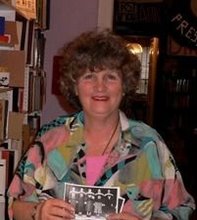
You are there! You are there!
The sun is beating down on us on Fitzgibbon Avenue here in West Brunswick in the state of Victoria. Cello and I hunker down in our home behind drawn blinds but I can still hear the rattling of the old trolleys going by. Is this the same Joan who walked to Zabar's and Fairway on the bustling, so full of itself Upper West Side Broadway. Yes, yes, made rich with glazes of tracks and new footpaths; yesterday, I sat under the shade of our apricot tree in the backyard and read John Le Carre's "Mission Song" while Vincent, our neighbor, chopped wood for his outdoor oven, just as he did as a young man in Calabria; now 70, he still farms his backyard as if it was acres and makes grappa in his garage. I like to hear his steps, the blows of his axe, Anna, his wife, calling to him in Italian, the only language she wants to speak, asking him to be careful, I imagine. How to explain how lives border each other, but they do, I feel the strength of Vincent's arm and he must hear my sighs. From now on while you in the Northern hemphisphere cool down, we here will warm up and watch the skies with anxious eyes for the promise of rain.
Thursday, November 15, 2007

Tuesday, November 13, 2007
In the beginning I did not realize how important to my own days, this way of talking, this immediate shaping of thoughts, of responses would be. So much I read and see breaks the heart, but words, these public-private words, shape the wrenching visions into something else. Last night, after La Profesora and I had eaten the special meal I had prepared to congratulate her on the end of her week of intensive teaching, I sat down to finish the blanket I was knitting, watching the American tv series NCIS. I watched this show a few months ago and became familiar with the woman character who is an Israeli-trained special agent--and wondered at how just the word "Israeli" has become a metaphor for useful brutality--you don't fool with this woman; she in fact is the show's torturer. Last night she is told to get the information out of a suspect in the way she knows how to do it--torture, she says, half a question. The next scene we see her with a gun to the bad guy's head threatening to kill him; the other episode I watched the first time, she is told again to use her expertise to get information and she answers just give me five minutes, I know a special place on the side of the neck that will make anyone talk. Here I am, at the other end of the world, watching a popular American TV drama where torture is part of the story line, in fact is part of the appeal of one of the characters, what you expect to see. How did this happen--how did torture become an acceptable plot device, a Deus ex machina of the 21st American century? As La Profesora has taught me, and Naomi Kline as well, norms shift in times deemed extreme and they do not usually shift back--particularly if the national power blocks like the new terrain. So first the unacceptable becomes a sad faced possiblity and then entertainment. The next show, also an American import, Numbers, opened with an image of student antiwar activist from the 60s now labeled a terrorist by an aging government agent. That was the end, I thought, until this morning when I was trying to get news and paused at the Fox Channel--there was O'Reilly showing grainy pictures of a new generation of young anti-Iraq war demonstrators shouting as he does that these were far left terrorists.
And the last image of the night, one that has haunted me even more then the others--an oil drenched sea bird, its features gone in a coat of suffocating oil, trying to open its beak, a black mass trying to breath, drops of oil falling from its open mouth. I think of all it needed to live--the sea and air--and how we have not allowed even this minimal habitat to be safe--in some way, it all connected for me--we are our own torturers and not all the money and armies and duplexes and country estates and stock investments will cleanse our air of broken bodies.
And the last image of the night, one that has haunted me even more then the others--an oil drenched sea bird, its features gone in a coat of suffocating oil, trying to open its beak, a black mass trying to breath, drops of oil falling from its open mouth. I think of all it needed to live--the sea and air--and how we have not allowed even this minimal habitat to be safe--in some way, it all connected for me--we are our own torturers and not all the money and armies and duplexes and country estates and stock investments will cleanse our air of broken bodies.
Monday, November 12, 2007
In July of 1999, I received an e-mail from Lepa Mladjenovic, a woman I did not know and who now is part of all that makes the human world, with all its armor and hatreds, a place of hope.
My name is Lepa Mladjenovic, and I am a feminist lesbian from Belgrade, Serbia. I've been wanting to write to you for some time.
I think the first time I thought of it was a couple of years ago, around the wa in Bosnia, and I was e-mailing with Women in Black from Israel, Haya Shalom, Gila Svirsky, and I saw your name on one e-mailing list, I saw your name there, ah!!! It was such a beautiful moment. It was such a feast! I was saying in my mouth, your name, my lesbian was rising...and my body was excited. In the middle of a working day in the Center [for women victims of war and other forms of violence]. I did not write you.
Now I have A Fragile Union on my pillow and I must write. So first I ask you how are you, and I send my greetings that I entered in your home, and then I wish to let you know that you are present in me sometimes, in some other lesbians in Belgrade and then in this region as well.
I remember that the first what I read from you was "My Mother Liked to Fuck," it was around 1988 and I was only becoming a lesbian with identity and I read that, and it was a shock to all my senses and my mind, and that was that!...So we translated it, at that time in Belgrade there was a small group of us who were making feminism and even smaller who were lesbians among them.
I bought "A Restricted Country" many times and gave it to many... Particularly it was during the Bosnian war time that I needed to read and reread you. From the beginning of wars in this region from 91 on, I felt that I have to invent Ten Thousand ways to let my lesbian desire breathe...At some moments during the last eight years it was not easy for me to put into words how do I feel when making love with a woman and in the back there is a radio with the news of war. Killed or expelled or other fascist acts. In my room, I would not be able to stand up from the bed, leave the desired bodies and swith off the news, also because I thought the respect to the killed I will show by not switching off the radio.
In one of the short articles on anti-war, I Mentioned at the end that reading Adrienne Rich, "Litany for Survival" by Audre Lord and essays of Joan Nestle kept the light of my soul alive in wartime alive. And you know what, in those times "The Gift of Touch" we read and re read in our lesbian group and translated and read agin, and photocopied and printed in our feminist notebooks that has 1000 copies and goes to women's groups to all the states of Former Yugoslavia free.
Dear comrade Joan,
I send you tender regards,
Lepa Mladjenovic
Belgrade, 3 of July, 1999
I have received many letters about my work over the years, but this letter from a woman who is a tireless worker for peace, these words from my now dear friend, words perhaps never said allowed before in a time of war, testifying to the strength of lesbian desire as a life force in the midst of national atrocities, live inside of me, honor me as a writer, the small writer I am, honor all who write of the yearning body in times of armored nationalisms. I think of the women of ASWAT, the Palestinian Lesbian group, I think of the Israeli butch-femme community I met that night in Jerusalem, of the queers of Israel and Palestine, of the transgendered people of war torn lands --words of embrace, of touch, of delight in the small curve, the flick of a tongue. And in that place, others too will find their bodies, remember the fragility of their flesh and know that free deep breaths are so simple and yet are made so impossible. Words, my friends, words, from a different mouth--find them in the shadows of the power brokers and you will have another history.
"After four years in operation, the Shushan pub, the only one for Jerusalem's gay and lesbian community, has closed down...Shushan is the only place in Israel where the Haredi [ultra-Orthodox], Arabs, religious and secular could sit together and have good time...when they left Shushan, each returned to his own ghetto." Reported by Jonathan Lis, Haaretz Correspondent, November 12, 2007
Here I must tell you that a wonderful and brave group of Israeli women are in the act of translating a selection of my work into Hebrew and a brave man will publish it. Words, words--may they touch and honor you.
My name is Lepa Mladjenovic, and I am a feminist lesbian from Belgrade, Serbia. I've been wanting to write to you for some time.
I think the first time I thought of it was a couple of years ago, around the wa in Bosnia, and I was e-mailing with Women in Black from Israel, Haya Shalom, Gila Svirsky, and I saw your name on one e-mailing list, I saw your name there, ah!!! It was such a beautiful moment. It was such a feast! I was saying in my mouth, your name, my lesbian was rising...and my body was excited. In the middle of a working day in the Center [for women victims of war and other forms of violence]. I did not write you.
Now I have A Fragile Union on my pillow and I must write. So first I ask you how are you, and I send my greetings that I entered in your home, and then I wish to let you know that you are present in me sometimes, in some other lesbians in Belgrade and then in this region as well.
I remember that the first what I read from you was "My Mother Liked to Fuck," it was around 1988 and I was only becoming a lesbian with identity and I read that, and it was a shock to all my senses and my mind, and that was that!...So we translated it, at that time in Belgrade there was a small group of us who were making feminism and even smaller who were lesbians among them.
I bought "A Restricted Country" many times and gave it to many... Particularly it was during the Bosnian war time that I needed to read and reread you. From the beginning of wars in this region from 91 on, I felt that I have to invent Ten Thousand ways to let my lesbian desire breathe...At some moments during the last eight years it was not easy for me to put into words how do I feel when making love with a woman and in the back there is a radio with the news of war. Killed or expelled or other fascist acts. In my room, I would not be able to stand up from the bed, leave the desired bodies and swith off the news, also because I thought the respect to the killed I will show by not switching off the radio.
In one of the short articles on anti-war, I Mentioned at the end that reading Adrienne Rich, "Litany for Survival" by Audre Lord and essays of Joan Nestle kept the light of my soul alive in wartime alive. And you know what, in those times "The Gift of Touch" we read and re read in our lesbian group and translated and read agin, and photocopied and printed in our feminist notebooks that has 1000 copies and goes to women's groups to all the states of Former Yugoslavia free.
Dear comrade Joan,
I send you tender regards,
Lepa Mladjenovic
Belgrade, 3 of July, 1999
I have received many letters about my work over the years, but this letter from a woman who is a tireless worker for peace, these words from my now dear friend, words perhaps never said allowed before in a time of war, testifying to the strength of lesbian desire as a life force in the midst of national atrocities, live inside of me, honor me as a writer, the small writer I am, honor all who write of the yearning body in times of armored nationalisms. I think of the women of ASWAT, the Palestinian Lesbian group, I think of the Israeli butch-femme community I met that night in Jerusalem, of the queers of Israel and Palestine, of the transgendered people of war torn lands --words of embrace, of touch, of delight in the small curve, the flick of a tongue. And in that place, others too will find their bodies, remember the fragility of their flesh and know that free deep breaths are so simple and yet are made so impossible. Words, my friends, words, from a different mouth--find them in the shadows of the power brokers and you will have another history.
"After four years in operation, the Shushan pub, the only one for Jerusalem's gay and lesbian community, has closed down...Shushan is the only place in Israel where the Haredi [ultra-Orthodox], Arabs, religious and secular could sit together and have good time...when they left Shushan, each returned to his own ghetto." Reported by Jonathan Lis, Haaretz Correspondent, November 12, 2007
Here I must tell you that a wonderful and brave group of Israeli women are in the act of translating a selection of my work into Hebrew and a brave man will publish it. Words, words--may they touch and honor you.
Thursday, November 8, 2007
I want to thank the two women who help me live in this strange mix of private-public space--Pattie and Shebar. Today I sit with John Ashcroft's New York Times shameful self-serving op-ed piece "Uncle Sam on the Line" before me--having come into the house to escape the growing afternoon heat--here in Melbourne, the Spring is warming up and here, as readers of my blog know and my in real space friends know even better, I live very different days, or better, my eyes see very different things, then they did in my over 40 years of life on the upper West side of New York City. Our little dog Cello lies daintly on his side in the shade of the huge tropical leaves that frame our verandah. He is further shadowed by the terrocotta pots, chipped and worn, overflowing with white and red geraniums and blue lobelia. My darling, La Profesora, is hard at work, co-teaching an intensive course on Women and War at the university. I have been sitting and drawing, little scenes from our garden that I will send friends for the holidays, and as I looked for the cast shadows on the pots, I fell into their tenderness. Let me explain. Two old, as I have said, earthern pots, one larger, rounder then the other and then there is a place where their roundnesses meet, where a curving tender edge is formed; leaves and flowers cascade down their shared sides but there it is, a place where things nestle into things, the slope of one kissing the curve of the other. Perhaps because the world seems so wrong now, or at least the parts of the human world with which I am concerned, that I am drawn to this need one thing seems to have for another, for touch that creates a different kind of boundary.
Then back at my desk, I look at the printed, hard words dated November 5, 2007 with Washington given as the point of origin. Let me give you a taste:
" Long standing principles of law hold that an American corporation is entitled to rely on assurances of legality from officials responsible for government activities....
Even more important than the inherent unfairness of requiring companies to second-guess executive-branch legal judgements are the acute dangers to which it would expose the country. One of our nation's most important comparative advantages over our adversaries is the creativity and robustness of the private sector. To cut ourselves off from that advantage would amount to a form of unilateral disarmament..."
Oh how warm the pots look, and how chilling the words "the private sector" freeze on the page--the free market, private sector, the free market run prisons, schools, wars, hospitals, water systems, and the free market sure can run--away from New Orleans and straight to Black Water operatives, away from civil liberties and straight to corporate enhancing surveillance of citizens as well as suspicious others, all under the patriotic cuteness "Uncle Sam on the Line." All of this would be bad humor, a democracy becoming its own Jonathan Swift--should we really eat our children--and the horror, the horror, so many Americans accept this caricature of their nation as the real thing or even worse, the good thing. Not even the closing italicized attribution--" John Ashcroft was the United States attorney general from 2001 to 2005. He now heads a consulting firm that has telecommunications companies as clients" brings roars of unbelieving laughter. So cheap they are selling this country, so obvious is their coldness--let us keep our words pouring out, those who remember a different way, a different time--let us keep alive the tenderness of mutual caring, for ourselves, for others, for the country that can be, for the world that can be, that tender touch of things we need to do so well for each other.
Then back at my desk, I look at the printed, hard words dated November 5, 2007 with Washington given as the point of origin. Let me give you a taste:
" Long standing principles of law hold that an American corporation is entitled to rely on assurances of legality from officials responsible for government activities....
Even more important than the inherent unfairness of requiring companies to second-guess executive-branch legal judgements are the acute dangers to which it would expose the country. One of our nation's most important comparative advantages over our adversaries is the creativity and robustness of the private sector. To cut ourselves off from that advantage would amount to a form of unilateral disarmament..."
Oh how warm the pots look, and how chilling the words "the private sector" freeze on the page--the free market, private sector, the free market run prisons, schools, wars, hospitals, water systems, and the free market sure can run--away from New Orleans and straight to Black Water operatives, away from civil liberties and straight to corporate enhancing surveillance of citizens as well as suspicious others, all under the patriotic cuteness "Uncle Sam on the Line." All of this would be bad humor, a democracy becoming its own Jonathan Swift--should we really eat our children--and the horror, the horror, so many Americans accept this caricature of their nation as the real thing or even worse, the good thing. Not even the closing italicized attribution--" John Ashcroft was the United States attorney general from 2001 to 2005. He now heads a consulting firm that has telecommunications companies as clients" brings roars of unbelieving laughter. So cheap they are selling this country, so obvious is their coldness--let us keep our words pouring out, those who remember a different way, a different time--let us keep alive the tenderness of mutual caring, for ourselves, for others, for the country that can be, for the world that can be, that tender touch of things we need to do so well for each other.
Saturday, November 3, 2007
I want to thank all of you that have taken the time to write me--Wendy who started it all, Stephanie whose questions I value, Barbara Ruth--an old time friend who has provided lasting proof of how deeply I was penetrated by the visions of the early years of lesbian-feminism, and Barbara, my uterus has remained grateful all these years, to BarbaraHammer, a pioneering film maker, to Esther with gratitude for her political and cultural work and to Mckn2 and Mike--whom I do not know, I think, and whose responses are as precious.
Wednesday, October 31, 2007
So long has passed since my last entry that I forgot how to get into my own blog--issues of memory are all around me--the death of dear friends, the dislocation of distance, a changing self in body and habits of thinking, moving.
What has been haunting me through so much of these times is the suffering of ill people behind these walls and check points and in war- torn towns. I have had colon and breast cancer--I have been able to take two Manhattan buses to get to my chemo center, to my radiation laboratory, to my surgeons. I am haunted by the image of a 14 year old Iraqi girl, thin as the pallet on which she lay, outside the gates of her family home in one of the most destroyed neighborhoods of Baghdad--her older brothers stood around her--she has cancer, she has not eaten but she can't go to the hospital, the arms of the girl waving, the translator saying she wants to go to the doctor, bare human suffering-the reporters convince one of her brothers to help them put her into their car and come with them as they try to find help for their sister. The car drives away into shadows. I do not know what happened to that young woman, but I read of the ill people in Gaza, of cancer stricken Palestinians stopped at closed gates or restricted in their travel, of treatment appointments missed or never made. Fine Israeli hospitals just moments away but not for these people--they are part of a population that must be punished, that must be exhausted as the head of Shin Bet said recently--we must make them too exhausted to engage in struggle against us. So many of us have endured life with cancer, we know how we accept poison into our bodies because that is all the doctors can offer now, we know the exhaustion of the body trying to absorb chemicals that want to kill it, and we know the exhaustion of the illness itself--if even a small number of us joined together, we who had to ask no one for permission to cross a road, who were never turned away from a departure point when we had used every bit of our energy to arrive there, if we used our human bond, stricken body with sticken body, we could break the walls that imprison all of us--those who suffer their lack of power and those of us who inflict our power down to the very cells of those we deem the enemy.
In America, politicians argue whether "illegal" immigrants should be allowed to get treatment for their cancer -- how can we who have survived because we "passed" the human requirements be silent in the face of this?
I live in Melbourne, Australia now--Australia is in the midst of an election--Liberal leader John Howard has been Prime Minister for 11 years, a devoted follower of George Bush and all things Right--today he said the most astounding thing--he answered critics of his meeting with the leader of an extreme right wing Christian group, League of Rights, by saying, "well, they are a bit anti-semitic" but refused to cut his ties to the group. The group's leader has gone on record questioning whether the Holocaust ever really happened. A bit antisemitic, a bit pregnant. I have written here of my sadnesses, angers, rejection of the actions of Israel as a nation state and its treatment of the Palestinians. That is one discourse and the other--the growing Christian fascism of the extreme right. Power, God, nationalism--and the human body, naked in its need for care.
What has been haunting me through so much of these times is the suffering of ill people behind these walls and check points and in war- torn towns. I have had colon and breast cancer--I have been able to take two Manhattan buses to get to my chemo center, to my radiation laboratory, to my surgeons. I am haunted by the image of a 14 year old Iraqi girl, thin as the pallet on which she lay, outside the gates of her family home in one of the most destroyed neighborhoods of Baghdad--her older brothers stood around her--she has cancer, she has not eaten but she can't go to the hospital, the arms of the girl waving, the translator saying she wants to go to the doctor, bare human suffering-the reporters convince one of her brothers to help them put her into their car and come with them as they try to find help for their sister. The car drives away into shadows. I do not know what happened to that young woman, but I read of the ill people in Gaza, of cancer stricken Palestinians stopped at closed gates or restricted in their travel, of treatment appointments missed or never made. Fine Israeli hospitals just moments away but not for these people--they are part of a population that must be punished, that must be exhausted as the head of Shin Bet said recently--we must make them too exhausted to engage in struggle against us. So many of us have endured life with cancer, we know how we accept poison into our bodies because that is all the doctors can offer now, we know the exhaustion of the body trying to absorb chemicals that want to kill it, and we know the exhaustion of the illness itself--if even a small number of us joined together, we who had to ask no one for permission to cross a road, who were never turned away from a departure point when we had used every bit of our energy to arrive there, if we used our human bond, stricken body with sticken body, we could break the walls that imprison all of us--those who suffer their lack of power and those of us who inflict our power down to the very cells of those we deem the enemy.
In America, politicians argue whether "illegal" immigrants should be allowed to get treatment for their cancer -- how can we who have survived because we "passed" the human requirements be silent in the face of this?
I live in Melbourne, Australia now--Australia is in the midst of an election--Liberal leader John Howard has been Prime Minister for 11 years, a devoted follower of George Bush and all things Right--today he said the most astounding thing--he answered critics of his meeting with the leader of an extreme right wing Christian group, League of Rights, by saying, "well, they are a bit anti-semitic" but refused to cut his ties to the group. The group's leader has gone on record questioning whether the Holocaust ever really happened. A bit antisemitic, a bit pregnant. I have written here of my sadnesses, angers, rejection of the actions of Israel as a nation state and its treatment of the Palestinians. That is one discourse and the other--the growing Christian fascism of the extreme right. Power, God, nationalism--and the human body, naked in its need for care.
Tuesday, October 16, 2007
Before I launch into my ideas about utopias for my dear now-sleeping friend, Hannah, I want to say, I know there are typos, spelling errors and sometimes errant letters that escape my delition button--sometime I will clean up all the mistakes produced by haste--this kind of writing for me comes quick and burning and so I am careless in ways writers should not be. I have only so much energy and for now, I pour it into the raw castings of my thoughts. And`another thing--I must have stifled responses after I replied directly to Wendy in my blog--or perhaps this is an act of my ego to think more then three minds have met mine. Please let me know if your read these words.
Now Hannah, why I cringe a little from "utopian" visions--and as I was thinking about this, I realized that the opposite of Utopia for me is the Diaspora--the permeable world of exchanges between differences, the yearning not for perfection or a blueprint of social conformities, but the shaping of hope from the real, from the clashings of multitudes of life. Now to write these words some 68 years after the Holocaust when Europe became a monster of exclusion unto death for all judged misfits and today, when in America "illegal" immigrants are marched away in the thousands, in the clothes they went to work in, the burly uniformed guards shepherding them away from hope, may appear naive, sentimental or self indulgent. But utopian dreams of perfected societies often carry within them all kinds of potential exclusions--I am not sure utopian thinking allows for much self criticism-- certainties of what should be, born from imaginations marked by their own time, often reflect, even in the imagining of a new state, the restrictions of the old. I think of race and class--as your example showed. In my lesbian feminist life, I have seen the workings of lesbian separatism--as expressed in the utopian--with a small u--world of the Michigan's Women's Music Festival. How wonderful--a place where women could be safe, where women's culture could be celebrated--yes, yes until the vision was challenged by a more gender complex world. What to do with transgendered woman, with women who started life as women but now live as men, with all the variations of the gender dispora, if I may say--then this radical vision of another world, to me, became a reactionary cultural geography where phrases like, "biologically born women only" stand guard at the camp's gates.
You asked me if utopias are suspect, then where do we find hope. In the mess, I want to say, in the mess. I think of the image of the Palestinian man in Gaza, dressed only in a short sleeved white shirt and pants, running towards a machine gun toting militant, trying to get the gun away from him, his civilian hands reaching out, turning the gun away--only a moment on the news covering the early days of Hamas' soldifying its power over the streets of Gaza--this man seemed almost naked in his despair at what Palestinians where doing to other Palestinians--no defenses only his out stretched arms--I almost did not breath so sure I was that in the height of the moments, with chaos all around, the wounded and dead lying the in the street, the freedom fighter would simply pull his trigger--I thought of the young Chinese student in Tiamen Square in front of the world-sized tank, of the half- naked monks of Burma, of the young and old Black Americans who marched down the streets of Selma and all over the American South, of the Jewish man who would not leave his wheel-chair bound Christian African-American work buddy on one of the doomed floors of the Trade Center, of the Israeli soldiers who refuse to serve in the Occupied Territories--Hannah, this is probably no help to you at all but I will continue.
I am not a scholar, have read no books about Utopian workings in the world--except the utopian fictions both of years ago and of the feminist movement--I understand the wonder and the need to articulate dreams of perfected societies--these dreams often grow out of the depths of how much we fail each other, they are calls to rethink institutions and social and economic traditions, they grow out of the paucity of the existing imagination--about gender, about justice, about equality, about love, about cities. Certainly the English and American socialist utopian communities of the 19th and 20 centuries helped to form a more humane modernity. So why am I not more drawn to utopian thinking--is it always being the daughter of an embezzeling mother, a neer do well, who got herself thrown out of so many decent worlds. I think I fear the joining of utopian thinking and nationalisms, of utopian thinking and power over who is human enough to live in the perfected future, of utopian thinking and the free market economy. We are back now, Hannah, as you lay peacefully sleeping, I hope, to the dilemma of your paper--to the dilemma of your women who saw Israel as a chance to make their dreams of a just society live in the desert--except for two problems: they were women and an indigenous people were living out their dreams there as well.
Now Hannah, why I cringe a little from "utopian" visions--and as I was thinking about this, I realized that the opposite of Utopia for me is the Diaspora--the permeable world of exchanges between differences, the yearning not for perfection or a blueprint of social conformities, but the shaping of hope from the real, from the clashings of multitudes of life. Now to write these words some 68 years after the Holocaust when Europe became a monster of exclusion unto death for all judged misfits and today, when in America "illegal" immigrants are marched away in the thousands, in the clothes they went to work in, the burly uniformed guards shepherding them away from hope, may appear naive, sentimental or self indulgent. But utopian dreams of perfected societies often carry within them all kinds of potential exclusions--I am not sure utopian thinking allows for much self criticism-- certainties of what should be, born from imaginations marked by their own time, often reflect, even in the imagining of a new state, the restrictions of the old. I think of race and class--as your example showed. In my lesbian feminist life, I have seen the workings of lesbian separatism--as expressed in the utopian--with a small u--world of the Michigan's Women's Music Festival. How wonderful--a place where women could be safe, where women's culture could be celebrated--yes, yes until the vision was challenged by a more gender complex world. What to do with transgendered woman, with women who started life as women but now live as men, with all the variations of the gender dispora, if I may say--then this radical vision of another world, to me, became a reactionary cultural geography where phrases like, "biologically born women only" stand guard at the camp's gates.
You asked me if utopias are suspect, then where do we find hope. In the mess, I want to say, in the mess. I think of the image of the Palestinian man in Gaza, dressed only in a short sleeved white shirt and pants, running towards a machine gun toting militant, trying to get the gun away from him, his civilian hands reaching out, turning the gun away--only a moment on the news covering the early days of Hamas' soldifying its power over the streets of Gaza--this man seemed almost naked in his despair at what Palestinians where doing to other Palestinians--no defenses only his out stretched arms--I almost did not breath so sure I was that in the height of the moments, with chaos all around, the wounded and dead lying the in the street, the freedom fighter would simply pull his trigger--I thought of the young Chinese student in Tiamen Square in front of the world-sized tank, of the half- naked monks of Burma, of the young and old Black Americans who marched down the streets of Selma and all over the American South, of the Jewish man who would not leave his wheel-chair bound Christian African-American work buddy on one of the doomed floors of the Trade Center, of the Israeli soldiers who refuse to serve in the Occupied Territories--Hannah, this is probably no help to you at all but I will continue.
I am not a scholar, have read no books about Utopian workings in the world--except the utopian fictions both of years ago and of the feminist movement--I understand the wonder and the need to articulate dreams of perfected societies--these dreams often grow out of the depths of how much we fail each other, they are calls to rethink institutions and social and economic traditions, they grow out of the paucity of the existing imagination--about gender, about justice, about equality, about love, about cities. Certainly the English and American socialist utopian communities of the 19th and 20 centuries helped to form a more humane modernity. So why am I not more drawn to utopian thinking--is it always being the daughter of an embezzeling mother, a neer do well, who got herself thrown out of so many decent worlds. I think I fear the joining of utopian thinking and nationalisms, of utopian thinking and power over who is human enough to live in the perfected future, of utopian thinking and the free market economy. We are back now, Hannah, as you lay peacefully sleeping, I hope, to the dilemma of your paper--to the dilemma of your women who saw Israel as a chance to make their dreams of a just society live in the desert--except for two problems: they were women and an indigenous people were living out their dreams there as well.
Subscribe to:
Posts (Atom)